7 Considerations to Selecting an SD-WAN Backbone Provider
What to weigh before committing global traffic to a backbone.

Why it is worth reading
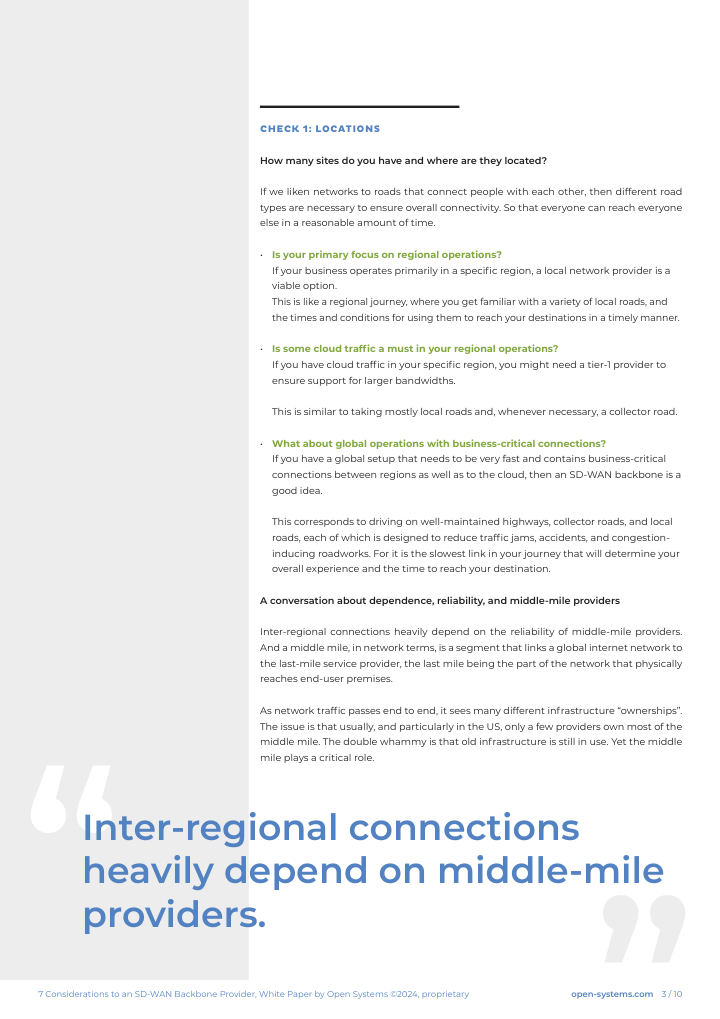
The slowest link in your network determines the entire end-to-end connection - and with it the user experience and the way business gets done. The tricky part: inter-regional traffic depends heavily on middle-mile providers you never contracted, often running aging infrastructure, and when a handover fails, nobody takes ownership of the problem.
This white paper walks through seven checks for evaluating an SD-WAN backbone provider: your locations and PoP density, the application landscape, sites in China, flexibility and resilience needs, SLA requirements, operations capabilities, and how the underlay harmonizes with the SD-WAN overlay. All told through one continuous road-trip analogy that keeps the trade-offs concrete.
What is inside
- Locations and the middle mileHow site count, PoP density and unreliable middle-mile providers decide your end-to-end performance.
- Application landscape and ChinaWhich business-critical apps justify a backbone - and why the Great Firewall makes VPN tunnels a non-option for compliant China connectivity.
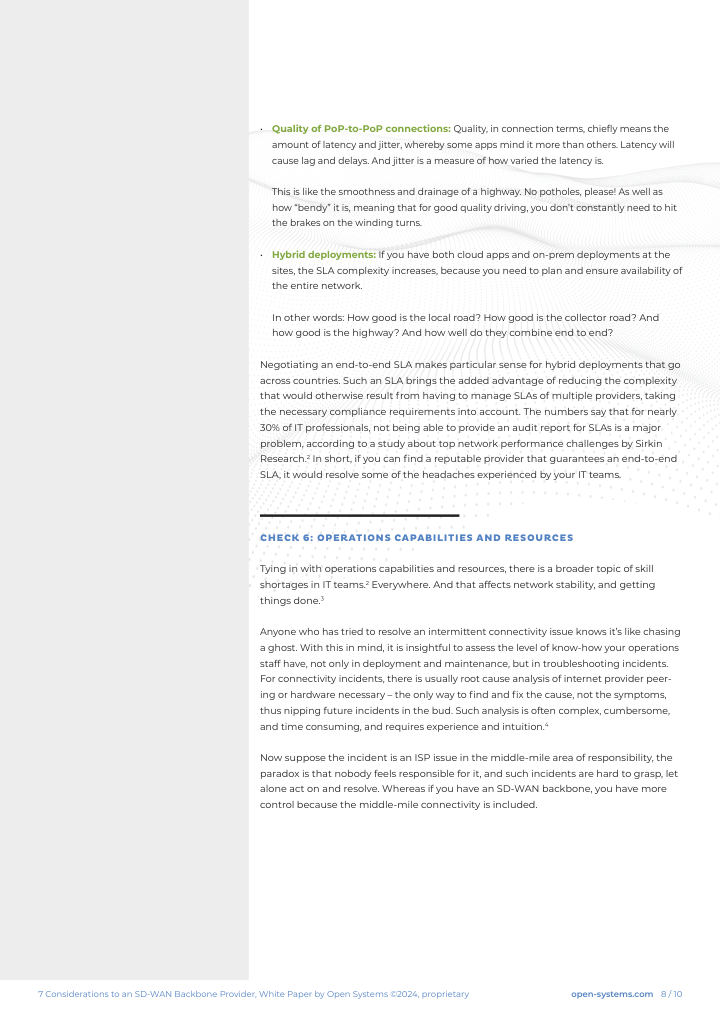
- Flexibility, resilience and SLAsHow fast new sites must connect, what downtime costs per hour, and what an end-to-end SLA should actually guarantee.
- Operations capabilitiesWhy intermittent connectivity issues are like chasing a ghost, and what root cause analysis demands of your team.
- Basis for SD-WANMaking the underlay harmonize with the SD-WAN overlay - encryption, direct routing and granular breakout - so the investment pays off.

The slowest link in your network is the determining factor of your entire end-to-end connection.Who it is for
- Network architects planning a global SD-WAN rollout
- IT leaders with sites in China or hard-to-reach regions
- Anyone about to negotiate SLAs with a backbone provider
Founded in Switzerland. Backed by Swiss Post.
Founded in Switzerland in 1990, Open Systems generates more than USD 100 million in annual revenue and supports global enterprise customers operating in more than 180 countries. Since 2024, the company has been part of Swiss Post, combining Swiss trust and stability with global reach. As a European alternative to US- and Israel-based cybersecurity providers, Open Systems is guided by strong principles around sovereignty requirements, regulatory alignment, transparency and shared responsibility - taking clear ownership for security, performance and operational outcomes, helping organizations maintain control in an increasingly complex digital landscape.
Autonomous SASE. AI-run. Human-backed.
You might also like.
Building a Network Business Case: Essential Data Insights for CIOs
The numbers a CIO needs to argue a network transformation.
Read more →
5 Key Mistakes Organizations Make with SD-WAN Security
The classic security gaps in SD-WAN projects, and the fixes.
Download PDF →
Secure SD-WAN: Helping CIOs Meet Their Goals
The CIO case for building security into the WAN.
Download PDF →