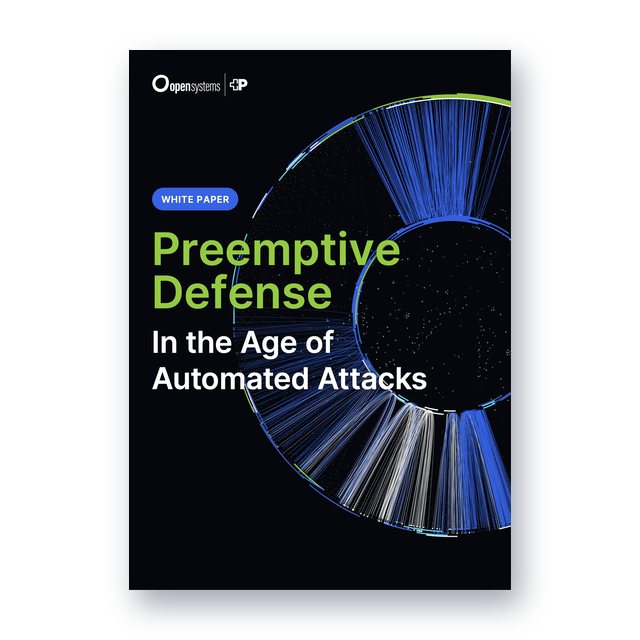
Preemptive Defense in the Age of Automated Attacks
Two lines of defense against automated attacks: cross-organization signal correlation at the perimeter and generative deception inside the network.
Why it is worth reading
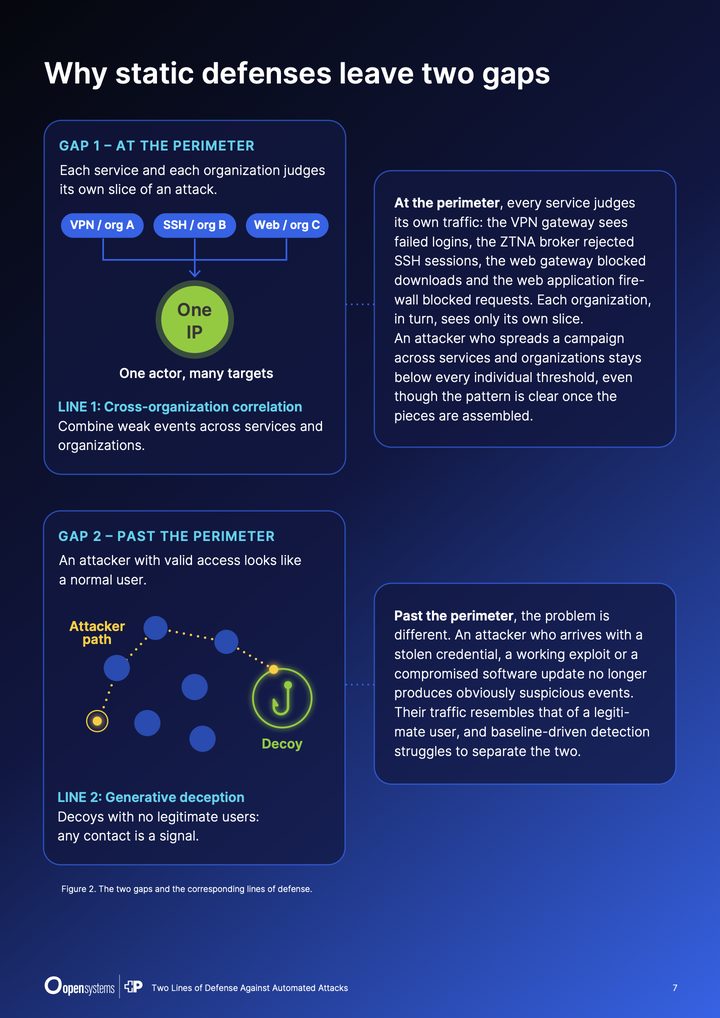
Static defenses leave two gaps. At the perimeter, each security service and each organization judges only its own slice of an attack, so campaigns spread across many targets stay below every individual threshold. Past the perimeter, an attacker with a stolen credential or a working exploit looks like a legitimate user. Automated and AI-assisted attacks are widening both gaps faster than human-led security operations can respond.
This white paper describes two complementary lines of defense: correlating weak security events across services and organizations at the perimeter, and placing generative decoys inside the network, where any interaction is a high-confidence detection. It shows both at work in a real campaign from November 2026, explains the different guardrails AI needs as analyst and as actor, and closes with the questions to ask any vendor.
What is inside
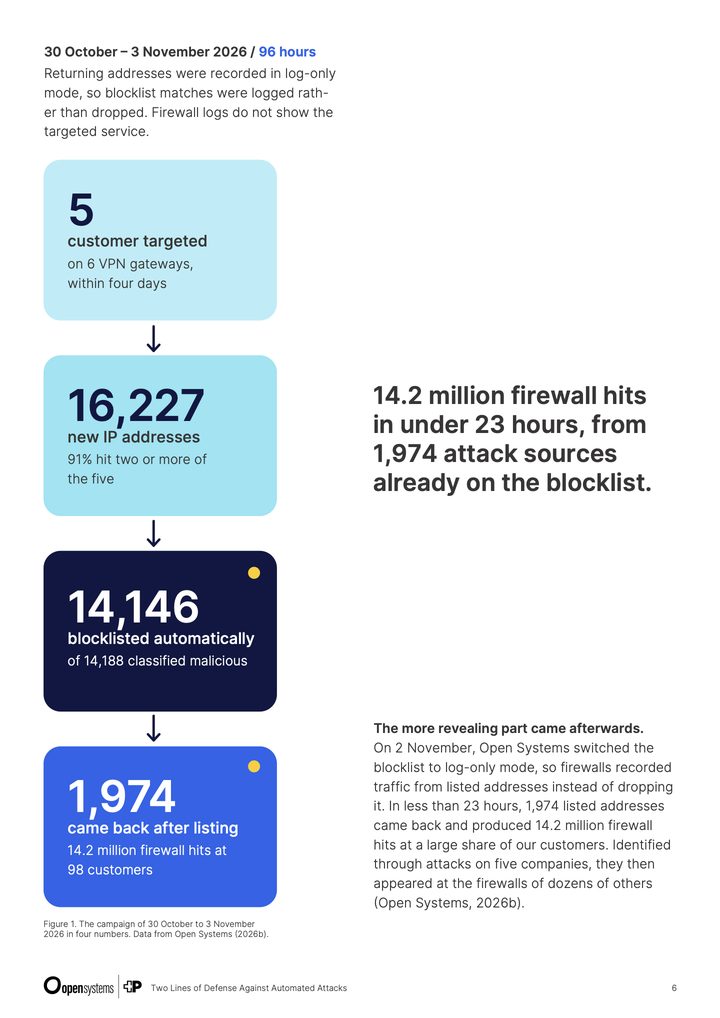
- A coordinated campaign that no single organization could seeBlocked VPN logins more than tripled within a day: only the combined view across customers revealed one distributed campaign.
- Why static defenses leave two gapsAt the perimeter every service judges its own slice; past it, an attacker with valid access looks like a normal user.
- Line 1: Cross-organization signal correlationWhy single events produce mostly false alarms, and how pooling weak signals across services and organizations exposes campaigns.
- Line 2: Generative deception inside the networkDecoys with no legitimate users need no baseline. Generative AI makes them credible, deterministic code keeps them consistent.
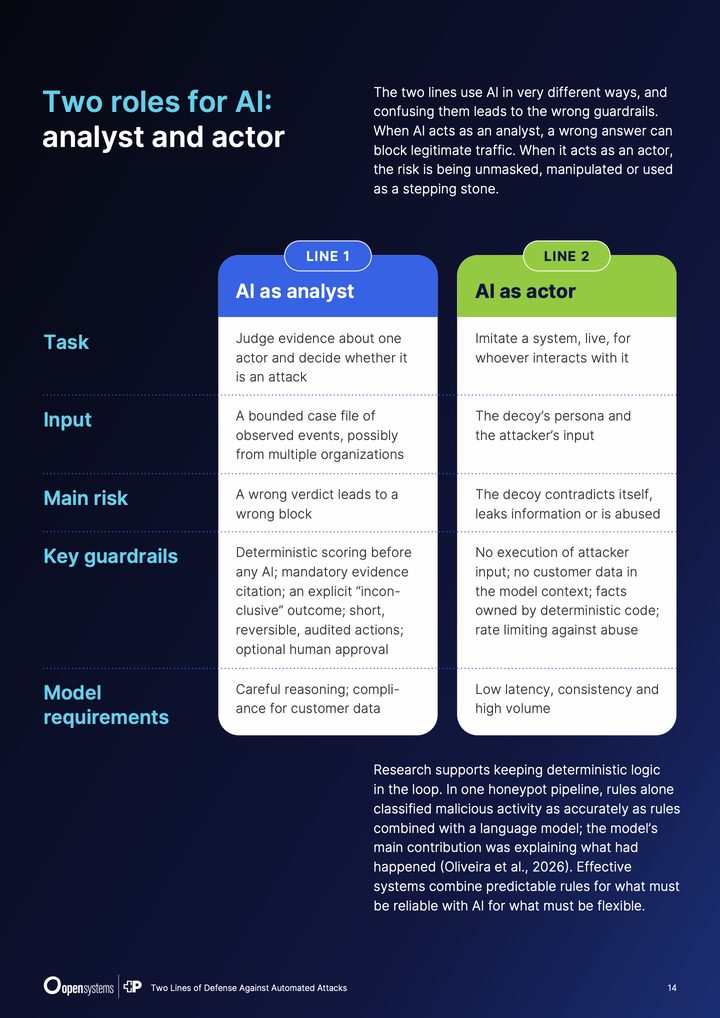
- Two roles for AI: analyst and actorDifferent risks need different guardrails, plus six questions to ask any vendor.
- Application, implementation and key takeawaysManufacturing with OT, banking and healthcare, the Open Systems implementation, and five takeaways for your strategy.

What changes the outcome is acting on reliable signals automatically, within limits that defenders set.Who it is for
- CISOs and security leaders planning a preemptive defense strategy
- Security architects evaluating correlation and deception approaches
- SOC and IT teams facing automated, AI-assisted attacks on remote access
Founded in Switzerland. Backed by Swiss Post.
Founded in Switzerland in 1990, Open Systems generates more than USD 100 million in annual revenue and supports global enterprise customers operating in more than 180 countries. Since 2024, the company has been part of Swiss Post, combining Swiss trust and stability with global reach. As a European alternative to US- and Israel-based cybersecurity providers, Open Systems is guided by strong principles around sovereignty requirements, regulatory alignment, transparency and shared responsibility - taking clear ownership for security, performance and operational outcomes, helping organizations maintain control in an increasingly complex digital landscape.
Autonomous SASE. AI-run. Human-backed.
You might also like.
Transform Your Network & Security Strategy with Managed SASE
IDC InfoBites: why enterprises hand SASE operations to a managed service.
Read more →
Navigating 2025 - Top 6 SASE Trends
The six shifts shaping SASE decisions in 2025.
Read more →
Secure Access Done Right
How SSE and ZTNA work together on the way to a zero-trust setup.
Read more →